Faith and skepticism
The Satanic VersesFaith and skepticism in The Satanic Verses are not simple opposites, with one standing for truth and the other for error. They are rival practices for interpreting experience: listening for revelation, demanding evidence, accepting authority, or refusing it. The novel tests those practices in scenes where belief generates solidarity and movement, but also where certainty exposes people to danger and skepticism is colored by personal interests. Its central question is not merely whether the miraculous can be proved, but who gets to name an experience miracle, delusion, or public threat.
Revelation and the Problem of Its Source
In Mahound’s account of revelation, faith begins in a form of listening that he understands as receptive yet not passive. He tells Salman the Persian that listening is also a kind of asking, and that Gibreel’s messages often seem to come from within his own deepest self. Salman warns that accepting Abu Simbel’s proposal to honor Lat, Uzza, and Manat could make Mahound appear to have tailored revelation for political advantage. Mahound answers with his experience of listening, but that answer cannot settle whether the voice comes from beyond him or from within. The uncertainty is built into the scene rather than resolved by it.
That ambiguity becomes more intense when Gibreel experiences himself as bound to Mahound during the latter’s listening. The two seem joined by a shining cord, and the dreamlike narration cannot determine which is dreaming the other. Mahound’s doubts also become audible through the encounter: he remembers the miracles that failed to persuade Jahilia’s people and questions whether he should accept the three goddesses for political gain. He cannot tell whether his own proposal would be wise, self-serving, or a betrayal. Gibreel, meanwhile, has no answer to give him. Faith here is not a settled possession; it is an effort made under pressure, with the source and meaning of revelation still uncertain.
Competing Claims to Authority
The Imam’s revolutionary project offers a stark contrast. His authority appears monumental and still, while his message travels through Bilal’s voice on surreptitious radio waves from Kensington toward an imagined Desh. The Imam presents history itself as an enemy, condemning progress, science, and rights as deviations from the completed truth of revelation. His aim is not to argue within historical time but to unmake history and recover the Paradise he believes lies beyond it. Yet this supposedly timeless message depends on modern communications and on Bilal’s trained, widely heard voice. The tension between rejecting modernity and using its instruments makes authority look less like a pure escape from history than a power operating through historical means.
The novel also shows how claims to rational authority can be forceful without being disinterested. When Mirza Saeed Akhtar tries to stop Ayesha’s pilgrimage, he invokes what modern men know: that old people die on long journeys, cancer is not cured by God, and oceans do not part. Those arguments express genuine concern for the villagers, including his wife, Mishal Akhtar, who is seriously ill. But Saeed’s skepticism is also bound up with his desire for Ayesha and his grief and estrangement as Mishal continues walking. His appeal to reason is therefore neither simply false nor detached from personal feeling.
A different dispute over the borders of belief arises when Alicja Cohen argues that Gibreel requires psychiatric confinement, recalling a story in which a delusion defeats a lie detector’s ability to identify truth. Allie answers by challenging the impulse to treat unfamiliar convictions as proof of madness. The exchange does not establish that Gibreel’s visions are true, nor does it confirm Alicja’s assessment as a diagnosis. Instead, it exposes the difficulty of separating faith, delusion, and prejudice by assertion alone.
The Pilgrimage as a Test of Belief
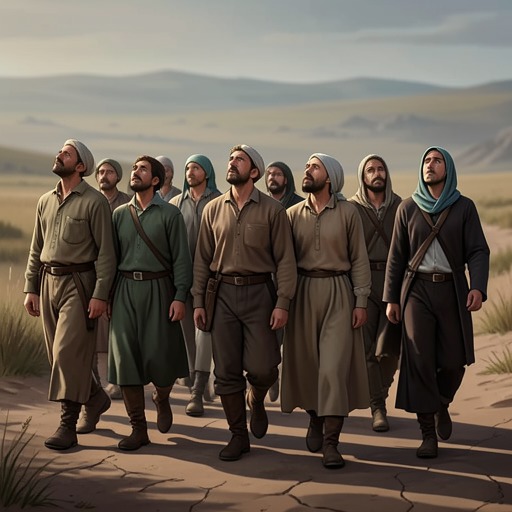
After her disappearance, Ayesha returns to Titlipur and tells the village council that Gibreel has given her a command: everyone is to walk to Mecca, kiss the Black Stone, and continue to the sea, where the waters will part. The council votes unanimously to obey. The villagers pool food, cooking utensils, and bedding, arrange for the youngest infants to be carried in rotation, and insist that the able-bodied walk rather than travel in litters. Their belief is thus made visible in discipline and shared labor; it is not only an idea but a collective undertaking with practical costs.
When the pilgrims reach Chatnapatna, the police initially treat their march as a sectarian demonstration. Mirza Saeed explains that they mean to walk to the Arabian Sea because they believe it will open. Srinivas, a Brahmin toy-maker, is moved by the procession, but his belief does not fit neatly into the opposition between Hindu devotion and Muslim pilgrimage: he says that the image of Lakshmi is in his heart, and recognizes Ayesha’s face as identical to that of the goddess pictured at his factory. His decision to join the walkers follows this personal recognition, while Sarpanch Muhammad Din and Khadija also continue on foot despite their age. The procession briefly brings people of different positions and convictions into a shared practice, without erasing their differences.
The road steadily makes the stakes concrete. Drought drives cattle and families south in search of water, while Mirza Saeed insists that the pilgrims are risking their lives for salt water and an impossible miracle. The journey proceeds at the pace of its slowest members, slowed by illness, officials, and the difficulties of the carts. On its eighteenth day Khadija dies after stopping at a ruined wayside inn. Saeed blames Ayesha, while Ayesha tells Muhammad Din that his wife’s death on pilgrimage assures her a place in Paradise. Muhammad Din cannot continue in the same unquestioning manner: unwilling to abandon the journey for which Khadija died, but unable to sustain its absolute faith, he accepts Saeed’s offer of a place in the station wagon. His change does not resolve the dispute; it reveals how grief can make belief and doubt coexist in a single choice.
Public Judgment and an Unresolved Ending
By the ninth week, the march has attracted journalists, politicians, commercial sponsors, tourists, and religious extremists. Photographs of Ayesha circulate, and her image appears on advertising hoardings. Visitors are unsettled by the butterflies that clothe her and provide her food; some respond by treating the pilgrims as objects of spectacle, while extremist groups accuse the march of appropriating a national tradition and inflaming communal tensions. The claims made about faith are now inseparable from the public struggle to define the pilgrimage: sacred command to its followers, political provocation to its opponents, and spectacle to outsiders.
At a mosque, Mirza Saeed presses Ayesha on why she does not repeat the angel’s precise words, asking how others can believe interpretations whose original wording is withheld. Ayesha replies that the angel speaks in clear and memorable forms, but the exchange leaves Saeed’s challenge unanswered. The scene returns to the earlier problem of revelation: even a confident witness mediates what is heard, and those who demand proof must decide what kinds of testimony they will accept.
At the Arabian Sea, the pilgrims enter the water, and none reappears. Saeed and other onlookers rush in to help; several survivors are pulled from the sea, while the pilgrims, including Ayesha and Mishal, are never seen again. The authorities later consider charging survivors with attempted illegal emigration and question them separately. The ending neither supplies public proof that the sea parted nor turns the event into a simple refutation of faith. It leaves the pilgrims’ disappearance, the survivors’ accounts, and the authorities’ legal framing in tension. Belief has produced a real journey and real consequences; skepticism has named its risks but cannot undo what happened or make its meaning uncontested.